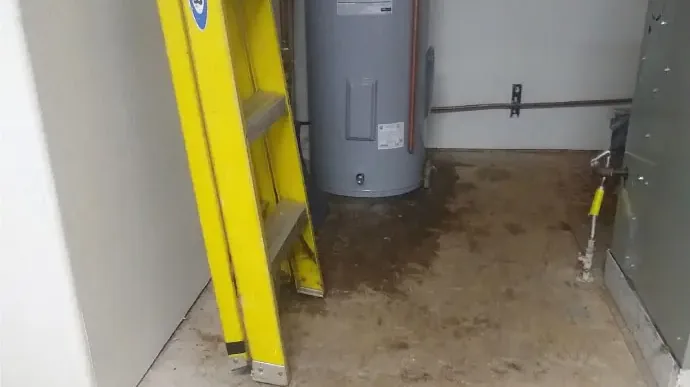
A water heater that fails does not leak politely. A full tank holds a lot of water, and a split seam or a bad fitting can push it across a utility room, under a wall and into the next room before anyone notices. In La Vergne, where Lake Forest Estates alone holds more than 3,100 homes, that scene can play out in garages, closets and hallway utility rooms across the whole subdivision.
Key takeaways
- Close the cold water inlet on top of the tank first, then switch off the breaker or set the gas control to off.
- Tank water starts out clean, but it becomes a drying job quickly once it reaches drywall, insulation and subfloor.
- The extraction crew pulls standing water and wet baseboards first, then sets the drying equipment.
- City Public Works handles water and sewer pipe problems, so a leak that starts outside the house is a report to the city.
- Photos and written moisture readings taken early keep the repair record clear for the insurer.
What a Failing Tank Does to a Utility Room
Most tank failures start small. A fitting weeps, a drain valve drips or the tank wall rusts through at a seam, and the water works its way along the floor long before a puddle shows.
Once a seam opens, the leak does not stop until the tank is empty or the supply is closed. A full tank adds up to a lot of wet floor.
- Rust streaks or crusty buildup around the pipe fittings on top of the tank
- A drain pan that is damp, stained or keeps filling
- A puddle that comes back after it has been wiped up
- Popping or rumbling from the tank while it heats
- A musty smell in the closet or garage corner where the tank sits
The First Steps When the Tank Lets Go
The order matters here. Water first, power second, belongings third.
Stop the supply
Find the cold water valve on the pipe that feeds the top of the tank and turn it clockwise until it stops. If it will not budge, the main shutoff for the house is the next stop.
Cut the heat source
An electric tank needs its breaker switched off before anyone steps near a wet floor. A gas tank has a control knob that turns to off.
If water has reached outlets, a power strip or the panel, stay away from the panel and bring in an electrician before going further.
- Move boxes, shoes and stored items off the wet floor
- Take photos of the tank, the floor and the wall base before anything is moved
- Open the garage door or a window to move air if the space is closed in
Lake Forest Estates and How a Leak Spreads
Lake Forest Estates is the largest subdivision of homes in Tennessee, with more than 3,100 homes. In a neighborhood that size, a water heater sits in a garage, a closet or a utility room in house after house, and the same few leak patterns repeat from street to street.
What matters is where the water goes next. The spot where the tank sits decides which materials get wet first.
Washers and dishwashers fail in similar ways, and the cleanup for those appliance leaks follows the same steps.
- Garage tank: water crosses the concrete and soaks stored boxes and the base of the wall
- Closet or hall utility room: water wicks into carpet, pad and the bottom of the drywall
- Attic or upper floor tank: water drops through the ceiling below and into the insulation above it
What the Extraction Crew Removes First
Standing water comes out first, using a pump or a wet vacuum, because water left on the floor keeps moving into the wall base. Water extraction also shows how far the leak actually traveled.
Next the crew checks what held the water. Baseboards, cabinet kick plates, carpet pad and the bottom edge of the drywall are the usual casualties.
Clean tank water is the easy case. Water that has spread across a dirty garage floor or sat for days is handled with more care, and the crew will say so.
- Standing water pumped or vacuumed off the floor
- Saturated carpet and pad lifted and removed
- Baseboard taken off so the wall cavity can breathe
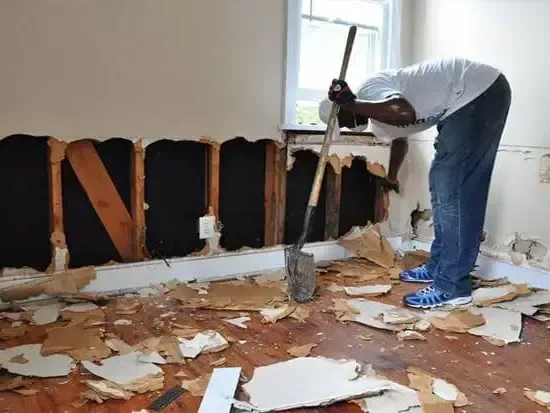
- Drywall cut back above the wet edge when water has wicked upward
- Wet insulation and soaked boxes bagged or moved out
How Drywall and Subfloor Are Dried
Speed matters because damp drywall and framing give mold a place to start if the water lingers for a couple of days. Structural drying is the step that closes that window.
Measure first
The drying team takes readings at the wall base, the subfloor and the framing, and writes them down. Those numbers show where the water went and, later, when it is gone.
Equipment that does the work
Air movers push dry air across wet surfaces while dehumidifiers pull the moisture out of the room. Small holes at the wall base let that air reach the cavity behind the drywall.
- Readings repeated daily until each material returns to a normal level
- Equipment repositioned as the wet area shrinks
- Subfloor and framing checked, not just the surface of the wall
When the Leak Starts Outside the House
City Public Works handles water and sewer pipe problems for La Vergne. A wet yard, a hissing meter box or water bubbling up near the street points to a pipe outside the home, and that is a report to the city rather than a tank problem.
Inside the house, the main valve stops everything at once while the tank is checked.
- Water at the meter or in the yard: report it to City Public Works
- Water only around the tank: close the cold inlet and start the cleanup
- Not sure where it starts: close the main valve and watch whether the water stops
After the Water Stops
Once the flow is stopped and the floor is damp rather than flooded, the drying plan begins. The tank needs a plumber, and the wet materials need the extraction and drying steps above; the full scope of water heater leak cleanup covers both sides of the job.
If a claim is possible, keep the old tank until the insurer has seen it, and keep every photo and every reading.
Questions
Can a slow water heater leak wait until tomorrow?
A slow drip may buy a little time, but a seam leak does not. Closing the cold inlet is quick, and it stops the tank from refilling and feeding the leak.
Is water from a tank heater clean?
It starts as clean supply water. Once it crosses a dirty floor or sits in carpet pad for a while, the pad is usually removed and the area is cleaned before drying.
Will the drywall always have to come out?
Not always. Drywall that stayed dry above the wet base can often stay, while wet insulation and soft baseboard usually go. The readings decide.
What does City Public Works handle?
City Public Works handles water and sewer pipe problems for the city, so a leak that starts outside the house is worth reporting there.
Does a gas water heater change the steps?
The gas control turns to off. Any smell of gas means leaving the house and contacting the gas utility before anything else.